AI Weekly Recap, Grok Bot, ChatGPT Redesign and Claude Cowork
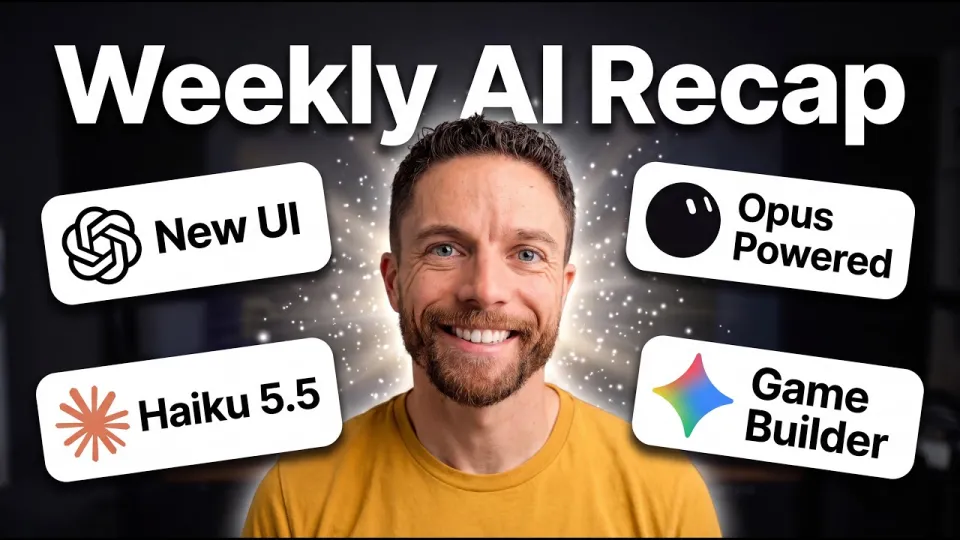
Video: Weekly AI Recap: GrokBot Just Did the Unthinkable, ChatGPT Looks Completely Different & More!
You can order the same kind of articles for your own video to boost it on YouTube and Google. Just message the Telegram bot @sat_sit_bot. The bot writes and publishes the articles itself (with your YouTube video embedded) on popular topical websites (no ads). Try it free: 50 articles on us.
· based on the channel Paul J Lipsky
AI news this week is dominated by one shift: assistants are turning into orchestrators. Grok Bot is being set up to route work to Claude, Midjourney and Suno, ChatGPT is getting a redesigned Intelligent UI, and Claude Cowork is moving to the cloud — three different bets on the same idea that the model matters less than the system around it. The full walkthrough is in Paul J Lipsky's weekly recap, and the sponsor link for the launch offer is Okou — try the platform and claim the launch promotion.
What the AI recap covers this week
The recap is organized as a day-by-day rundown rather than a single headline, which is why it fits a week in which no single release dominated. The structure follows the video's chapter order: Grok Bot first, then OpenAI, Anthropic and Google, with a closing section of personal takeaways.
- Grok Bot — the largest segment, covering a plan to hand tasks to Claude, Midjourney and Suno instead of relying on a single in-house model.
- OpenAI — the new Intelligent UI for ChatGPT and what changes for everyday users.
- Anthropic — Claude Cowork moving to the cloud, plus Claude Haiku 5.5 in the update cycle.
- Google — Gemini plan changes, a hands-on test of Google Playground, and the Nano Banana 2.1 image model.
One viewer described using a Grok Bot agent on a folder of business videos in Google Photos: it produced a voice script, accepted the recorded audio back, and returned an edited social video that the viewer rated above the work of a paid contractor. That anecdote is the clearest illustration of what "orchestration" means in practice — the assistant coordinates tools rather than just answering prompts.
Grok Bot as an orchestrator, not a single model
Grok Bot's headline move is a plan to use third-party models and creative tools — Claude, Midjourney and Suno — inside its own workflow. Instead of competing on raw model quality alone, the bot would decide which engine fits a task: Claude for reasoning and long-form text, Midjourney for images, Suno for audio.
That architecture has three practical consequences:
- Task routing becomes the product. The quality of the result depends on whether the bot picks the right tool, not only on the underlying model.
- Costs and limits stack. Each external service has its own quotas and pricing, so a multi-tool agent is only as reliable as its weakest integration.
- Permissions matter more. An agent that can write files, generate media and call other APIs needs clear boundaries on what it may touch.
The viewer demo above shows the upside: a single instruction produced a script, an edit and a finished video. The risk is the same as the reward — an agent with that much reach is doing real work on real files, so scope and review steps are not optional.
ChatGPT's Intelligent UI changes the interface
The ChatGPT redesign is framed as an Intelligent UI: the interface adapts to what the user is doing instead of presenting one static chat box. In practice, that means the product surfaces the right controls, artifacts and context for a task rather than forcing every request through the same text field.
For users, the practical effects are usually these:
- Less prompt engineering for routine jobs. Structured tasks get structured inputs, so users spend less time describing format.
- Outputs become objects, not messages. Documents, tables and code increasingly live in their own panels that can be edited and reused.
- Interface churn is real. A redesign resets muscle memory, and features people relied on can move or change behavior between sessions.
That last point is worth planning for. Teams that built internal guides around specific buttons should re-check their instructions after a UI rollout rather than assume the old screenshots still apply.
Claude Cowork moves to the cloud
Claude Cowork's move to the cloud shifts multi-step agent work off the local session and onto Anthropic's infrastructure. The point of Cowork is collaborative, task-level work: the assistant takes a goal, breaks it into steps, and works through files and tools rather than producing a single reply.
Running that in the cloud changes the trade-offs:
- Persistence. Long jobs no longer depend on a laptop staying open and connected.
- Data location. Files used in a task are processed in Anthropic's environment, which raises the usual questions about what may be uploaded.
- Team use. Cloud execution is what makes shared, repeatable workflows practical across more than one person.
The same update cycle also touches Claude Haiku 5.5, the smaller, faster tier that matters for high-volume or latency-sensitive work. For most teams the split is straightforward: the large models for hard reasoning, the Haiku line for the many cheap calls an agent makes along the way. A recurring request in the comments — a Claude Code walkthrough written for non-technical users — reflects the same gap: the tooling is powerful, but the on-ramp is still steep.
Google: Gemini plans, Playground and Nano Banana 2.1
Google's segment covers three separate threads. First, Gemini plan changes: subscription tiers and what each includes are being reshuffled, and one viewer noted that a higher storage tier now bundles access to the Pro model — a detail worth checking against the current plan page before upgrading. Second, a hands-on test of Google Playground, the experimental surface for trying models and features before they ship broadly. Third, Nano Banana 2.1, the next iteration of Google's image model, which continues the pattern of frequent, incremental image-quality releases rather than one big launch.
Taken together, the Google news is less about a single product and more about packaging: which model sits behind which plan, and how experimental tools graduate into paid tiers.
Common questions from the AI recap audience
The comments under the recap surface a few recurring concerns that are worth addressing directly.
"I deleted a bot I didn't recognize — can I get it back?" A viewer described removing a newly appeared bot because it looked unfamiliar, assuming another assistant had gone off-script. The lesson is procedural: when a new agent or bot appears in an account, check the provider's release notes before deleting it, and look for a restore or re-enable option in settings rather than assuming removal is permanent.
"Which plan actually includes the Pro model?" Plan contents change faster than most comparison articles are updated. Verify against the provider's own pricing page on the day you subscribe, and check storage, model access and rate limits separately — they are often bundled in ways that are not obvious from the tier name.
"Can a non-technical person use these agent tools?" The most-liked requests under the video ask for a Claude Code tutorial aimed at non-developers. The honest answer is that agent tools reward clear task descriptions and careful file permissions more than coding skill, but the setup steps still assume some comfort with installing and configuring software.
Conclusion
The through-line this week is that AI products are being rebuilt as systems rather than models: Grok Bot routing work to Claude, Midjourney and Suno, ChatGPT reshaping its interface around tasks, Claude Cowork running agents in the cloud, and Google reshuffling what each Gemini plan includes. The practical advice is unglamorous — verify plan details at the source, keep permissions tight on any agent that touches real files, and expect interface changes to invalidate old instructions. Paul J Lipsky's weekly format, organized by day and company, is a useful way to track that pace without reading every changelog. If you want to test the orchestration trend yourself, start with Okou through the launch link and use promo code KJZN8RVG for 20% off one month of the Pro or Team plan, limited to 100 redemptions.
Key takeaways
- Grok Bot is positioned as an orchestrator that routes tasks to external models and tools such as Claude, Midjourney and Suno.
- ChatGPT gets an Intelligent UI that changes how the interface adapts to the task instead of showing one fixed chat window.
- Claude Cowork moves to the cloud, so multi-step agent work runs on Anthropic's infrastructure rather than a local session.
- Google's week centers on Gemini plan changes, the Playground test and the Nano Banana 2.1 image model.
- The recap is published by Paul J Lipsky and is sponsored by Okou, with a 20% one-month promo code limited to 100 redemptions.
Source: Weekly AI Recap: GrokBot Just Did the Unthinkable, ChatGPT Looks Completely Different & More! · Markdown version
Questions & answers
What is Grok Bot's plan to use Claude, Midjourney and Suno?
According to the weekly recap, Grok Bot is being set up to route tasks to external tools instead of relying only on its own model — Claude for text and reasoning, Midjourney for images, Suno for audio. The practical effect is that the bot acts as an orchestrator that picks an engine per task. Reliability then depends on each integration's limits and on how tightly permissions are scoped.
What changes with ChatGPT's Intelligent UI?
The redesign makes the interface adapt to the task instead of showing one fixed chat window, so structured jobs get structured inputs and outputs live in editable panels. For users, the main benefit is less prompt formatting work; the main cost is that familiar buttons and flows may move. Teams should re-check internal guides after the rollout.
What does Claude Cowork moving to the cloud mean for users?
Cloud execution means multi-step agent jobs keep running without a local session staying open, which makes shared team workflows practical. It also means files used in a task are processed on Anthropic's infrastructure, so data-handling rules matter. The same update cycle also touches the faster Claude Haiku 5.5 tier used for high-volume calls.
Did Google change what its Gemini plans include?
Yes — the recap covers Gemini plan changes, and viewers noted that higher storage tiers can bundle access to the Pro model. Because bundle contents shift often, check the provider's current pricing page before upgrading and compare storage, model access and rate limits separately rather than trusting the tier name.